logo
전화 번호:
Tellhow Technology (Chongqing) Co., Ltd.
저희 모터로 에너지를 절약하고 성공을 이루세요!
블로그

WEG Synchronous Motors Boost Industrial Efficiency Power Factor

제가 지금 온라인 채팅 해요
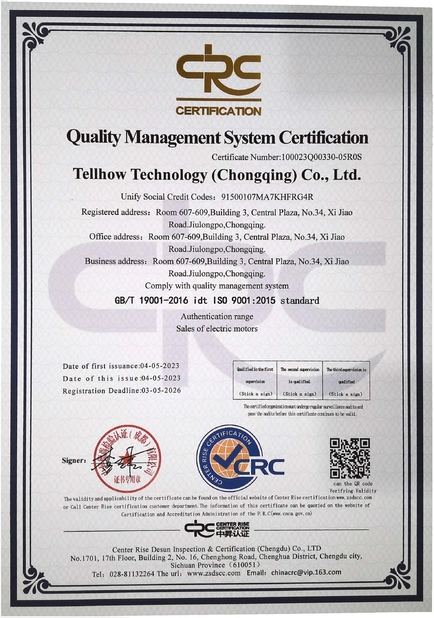
인증
중국 Tellhow Technology (Chongqing) Co., Ltd. 인증
고객 검토
모터는 저소음으로 완전히 운영하고 비디오 원격 설치 안내 서비스가 우수합니다. 우리의 지도자들은 매우 충족합니다.

—— 미샤 글래더쉬첸코

공장은 기술에 대해 매우 혹독하고 심각하고, 우리의 사용 환경에 따라 모터에 대한 세부를 조정하기 위한 매우 과학적 제안을 할 수 있습니다. 이것은 매우 믿을 만한 회사입니다.

—— 최근 미사용 리즈키 아말리아

회사 블로그
WEG Synchronous Motors Boost Industrial Efficiency Power Factor
에 대한 최신 회사 뉴스 WEG Synchronous Motors Boost Industrial Efficiency Power Factor

Imagine an industrial heart—your electric motors—not just synchronizing perfectly with power systems but actively optimizing energy bills and boosting productivity. This is not science fiction; it's the reality enabled by synchronous motors, with WEG motors leading the charge in redefining industrial drive systems through exceptional performance and reliability.

The Synchronous Advantage: Dancing with Time

The term "synchronous" originates from ancient Greek, meaning "in time with." True to its name, a synchronous motor's rotational speed precisely matches the power supply frequency, functioning like a flawless clock to ensure industrial stability and consistency. Unlike induction motors, synchronous motors employ DC excitation to generate their main magnetic field rather than relying on induced currents in stator windings. This design grants them unique advantages.

Dual Capabilities: Powerhouse and Grid Guardian

Synchronous motors serve two critical roles: highly efficient electromechanical energy converters and power factor correctors for electrical systems. They not only drive industrial equipment with superior efficiency but can also operate at leading, lagging, or unity power factor by adjusting excitation current. In power systems, low power factor causes energy waste and equipment overload. Synchronous motors counteract this by providing capacitive reactive power to offset inductive loads, improving power factor and reducing electricity costs.

Compact Design, Mighty Performance

Synchronous motors utilize larger air gaps, enabling the production of low-speed models even at lower power ratings. Particularly in low-speed applications and high-power high-speed scenarios, synchronous motors often outperform squirrel-cage induction motors of equivalent power in terms of size and cost, resulting in more compact layouts and economical investments.

Versatile Applications: Powering Possibilities

Synchronous motors can drive virtually any load typically handled by NEMA Design B squirrel-cage motors. However, certain applications benefit especially from their use:

  • Compressors: Direct coupling eliminates transmission losses, enhancing efficiency.
  • Pumps & Fans: Variable frequency control enables precise flow adjustment, reducing energy consumption.
  • Grinders & Crushers: Stable rotational speed ensures uniform material processing.
  • Paper Machines: Constant speed maintains product quality and consistency.
Six Key Advantages of Synchronous Motors
  1. Exceptional Efficiency: Among the most efficient industrial motors, maximizing energy conversion and reducing operational costs.
  2. Power Factor Correction: Operating at leading power factor improves system efficiency, potentially offsetting initial investment through electricity savings.
  3. Reduced Maintenance: Brushless excitation systems minimize upkeep, requiring only periodic inspections and cleaning.
  4. Space Savings: Engine-type designs allow direct shaft connection, eliminating couplings and bases.
  5. Constant Speed: Unaffected by voltage or load fluctuations, ensuring process stability (e.g., uniform paper quality in pulp machines).
  6. Adjustable Speed: When paired with magnetic drives or VFDs, enables demand-based speed control for additional energy savings.
Power Factor: The Efficiency Metric

Power factor—the ratio of real power (kW) to apparent power (kVA)—measures electrical system efficiency. A unity power factor (1.0) indicates all current performs useful work. Low power factors signify wasteful reactive current circulation. Synchronous motors correct this by adjusting excitation current to control magnetic field strength, supplying reactive power to counteract inductive loads.

Technical Deep Dive: How Synchronous Motors Work

Once synchronized, the motor's rotor poles align with the stator's rotating magnetic field. DC excitation current can replace all or part of the magnetizing current; excess excitation attempts to increase line voltage, creating leading power factor operation. Synchronous torque relates to the load angle (typically 20–30 electrical degrees at full load). The motor maintains sync even under constrained loads by temporarily adjusting speed until torque balances the load.

Industry Standards & Components
  • Frame: Supports/protects the motor in horizontal/vertical configurations.
  • Stator: Stationary magnetic assembly with core and AC windings.
  • Rotor: Rotating assembly with poles, excitation windings, and damper windings for self-starting capability.
  • Exciter: Provides DC current via brushless rotating systems.
Critical Torque Characteristics
  1. Breakaway Torque: Initial torque at zero speed.
  2. Acceleration Torque: Net torque from standstill to pull-in speed.
  3. Pull-up Torque: Minimum torque during acceleration.
  4. Pull-in Torque: Transition torque at ~95% synchronous speed.
  5. Synchronous Torque: Steady-state operational torque.
  6. Pull-out Torque: Maximum sustainable torque before desynchronization.
Synchronous vs. Induction Motors: Selection Guidelines

While synchronous motors handle any NEMA B induction motor load, selection depends on:

  • Cost-Efficiency: Synchronous units often prove economical above 1 HP/rpm, especially below 500 rpm.
  • Special Requirements: Preferred for very high power (e.g., 10,000+ HP at 3600 rpm), low-speed applications, or where power factor correction is critical.
  • Trade-offs: Require excitation systems and have higher maintenance with slip rings.
Compressor Applications: A Prime Example

Reciprocating compressors account for more synchronous motor applications than all other loads combined due to:

  1. Low starting/pull-in torque requirements when unloaded.
  2. Elimination of belts, chains, and gears.
  3. High efficiency and power factor in direct-coupled low-speed designs.
  4. Minimal footprint and maintenance.
Speed Control Innovations

Though inherently constant-speed devices, modern synchronous motors achieve variable-speed operation through load-commutated inverters (LCIs) or variable frequency drives (VFDs). These technologies enable:

  • Soft starting with reduced inrush current.
  • Energy savings by matching speed to demand (e.g., pumps/fans).
  • Super-synchronous speeds (>line frequency).
  • Quieter operation at reduced speeds.
선술집 시간 : 2026-01-31 00:00:00 >> 블로그 목록
연락처 세부 사항
Tellhow Technology (Chongqing) Co., Ltd.

담당자: Mr. Alex Yip

전화 번호: +86 2386551944

회사에 직접 문의 보내기
Tellhow Technology (Chongqing) Co., Ltd.
3, 센트럴 플라자, No.34, 시 지아오 길을 건설하는 607-609. 충칭. 중국
전화 번호:86-155-23661144
모바일 사이트 개인 정보 정책 | 중국 좋은 품질 고전압 교류 전동기 협력 업체. © 2022 - 2026 Tellhow Technology (Chongqing) Co., Ltd.. All Rights Reserved.