logo
전화 번호:
Tellhow Technology (Chongqing) Co., Ltd.
저희 모터로 에너지를 절약하고 성공을 이루세요!
블로그

Threephase Synchronous Motors Principles and Industrial Applications

제가 지금 온라인 채팅 해요
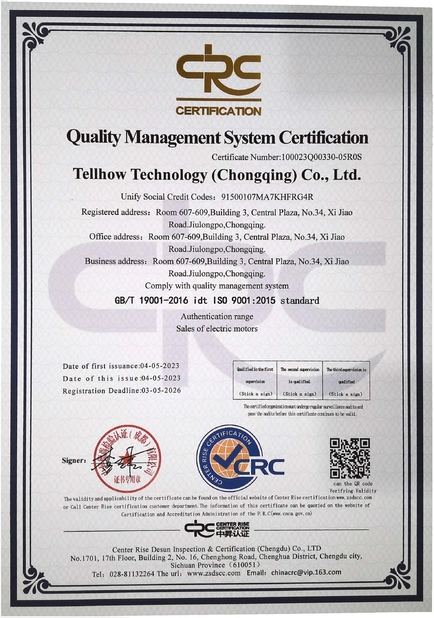
인증
중국 Tellhow Technology (Chongqing) Co., Ltd. 인증
고객 검토
모터는 저소음으로 완전히 운영하고 비디오 원격 설치 안내 서비스가 우수합니다. 우리의 지도자들은 매우 충족합니다.

—— 미샤 글래더쉬첸코

공장은 기술에 대해 매우 혹독하고 심각하고, 우리의 사용 환경에 따라 모터에 대한 세부를 조정하기 위한 매우 과학적 제안을 할 수 있습니다. 이것은 매우 믿을 만한 회사입니다.

—— 최근 미사용 리즈키 아말리아

회사 블로그
Threephase Synchronous Motors Principles and Industrial Applications
에 대한 최신 회사 뉴스 Threephase Synchronous Motors Principles and Industrial Applications

Imagine a massive rotating machine that converts mechanical energy into the electricity we depend on daily—or conversely, drives heavy industrial equipment with precision. This is the three-phase synchronous motor, a cornerstone of modern power systems. This comprehensive analysis explores its fundamental principles, operating characteristics, starting methods, and diverse applications.

I. Fundamental Principles of Synchronous Motors

Synchronous motors serve as electromechanical energy converters, transforming mechanical energy into electrical energy and vice versa. This conversion relies on two fundamental electromagnetic laws:

1. Faraday's Law of Electromagnetic Induction

This principle explains how electromotive force (EMF) generates when conductors cut through magnetic flux lines. The induced EMF's magnitude correlates with the magnetic flux change rate, while its direction follows Lenz's Law—the induced current's magnetic field always opposes the flux change that created it.

2. Electromagnetic Force Law

This law describes the force exerted on current-carrying conductors within magnetic fields. The force's magnitude depends on current strength, magnetic field intensity, and the conductor's effective length, with direction determined by the left-hand rule. This interaction produces the torque essential for motor operation.

II. Advantages of Three-Phase Synchronous Motors

While single-phase synchronous motors find use in small appliances, large AC motors predominantly employ three-phase configurations due to significant advantages:

  • Higher Power Output: Three-phase motors deliver approximately 150% more power than single-phase equivalents of comparable size, enabling greater energy efficiency and load capacity.
  • Cost-Effective Power Transmission: Three-phase systems demonstrate superior economic efficiency in electricity distribution, reducing line losses and equipment costs.
  • Self-Starting Capability: Most three-phase motors (excluding pure synchronous types requiring auxiliary starting) initiate operation without additional starting mechanisms.
  • Consistent Torque Production: These motors generate perfectly uniform continuous torque, eliminating the pulsating torque characteristic of single-phase motors, ensuring smooth and reliable operation.
III. Structural Components

Three-phase synchronous motors comprise two primary components—stator and rotor—with classifications based on excitation methods: electrically excited or permanent magnet variants. Electrically excited types further divide into salient-pole and cylindrical rotor designs.

1. Stator Construction
  • Core: Laminated silicon steel sheets minimize eddy current losses while housing winding slots.
  • Windings: Three-phase windings generate rotating magnetic fields, typically connected in star (Y) or delta (Δ) configurations.
  • Frame: Provides structural support and thermal dissipation pathways.
2. Rotor Configurations
  • Salient-Pole: Features protruding poles with non-uniform air gaps, commonly applied in low-speed applications like hydroelectric generators.
  • Cylindrical: Exhibits smooth surfaces with uniform air gaps, preferred for high-speed operations such as turbo generators.
  • Field Windings: DC-powered coils establishing the rotor's magnetic field.
IV. Synchronous Generator Operation

Synchronous generators (alternators) convert mechanical energy to AC electricity through electromagnetic induction—where conductor movement through magnetic fields induces voltage.

Key Operational Elements
  • Excitation System: DC power supplied to rotor windings via auxiliary generators (excitors).
  • Prime Movers: Mechanical drivers (turbines, engines) determine output frequency through rotational speed.
  • Synchronization: Rigid correlation between frequency (f), pole pairs (P), and RPM (N): f = (P × N)/120.
V. Voltage Generation Principles

The EMF equation E = 4.44K c K d fTΦ quantifies generator output, incorporating:

  • Winding turns (T)
  • Magnetic flux per pole (Φ)
  • Frequency (f)
  • Distribution (K d ) and pitch (K c ) factors
VI. Synchronous Motor Mechanics

These AC motors maintain strict synchronization between rotor speed and stator field rotation, requiring separate DC excitation for rotor magnetization.

Operational Characteristics
  • Dual Excitation: AC-powered stator creates rotating fields; DC-fed rotor establishes fixed fields.
  • Magnetic Locking: Rotor poles synchronize with stator fields near synchronous speed (N s = 120f/P).
  • Torque Generation: Power angle differential produces proportional electromagnetic torque.
  • Non-Self-Starting: Requires external acceleration methods due to inertial limitations.
VII. Starting Methodologies

Specialized techniques overcome inherent starting challenges:

1. Auxiliary Motor Starting

Secondary motors (induction or DC types) accelerate the rotor before applying DC excitation.

2. Damper Winding Implementation

Embedded squirrel-cage windings enable asynchronous starting, transitioning to synchronous operation upon reaching near-synchronous speeds.

3. Variable Frequency Drive

Modern inverters gradually increase supply frequency, offering smooth acceleration with minimal current surges.

VIII. Industrial Applications

Unique operational characteristics enable diverse implementations:

  • Power Factor Correction: Excitation control enables reactive power compensation as synchronous condensers.
  • Precision Speed Regulation: Ideal for textile machinery, paper processing, and precision tooling requiring exact RPM maintenance.
  • High-Torque Low-Speed Drives: Excels in compressor, mill, and pump applications.
  • Servo Systems: Permanent magnet variants dominate robotics and CNC equipment due to superior power density and control precision.
선술집 시간 : 2026-06-05 00:00:00 >> 블로그 목록
연락처 세부 사항
Tellhow Technology (Chongqing) Co., Ltd.

담당자: Mr. Alex Yip

전화 번호: +86 2386551944

회사에 직접 문의 보내기
Tellhow Technology (Chongqing) Co., Ltd.
3, 센트럴 플라자, No.34, 시 지아오 길을 건설하는 607-609. 충칭. 중국
전화 번호:86-155-23661144
모바일 사이트 개인 정보 정책 | 중국 좋은 품질 고전압 교류 전동기 협력 업체. © 2022 - 2026 Tellhow Technology (Chongqing) Co., Ltd.. All Rights Reserved.