logo
전화 번호:
Tellhow Technology (Chongqing) Co., Ltd.
저희 모터로 에너지를 절약하고 성공을 이루세요!
블로그

Threephase Induction Motors Key Industrial Workhorses Explained

제가 지금 온라인 채팅 해요
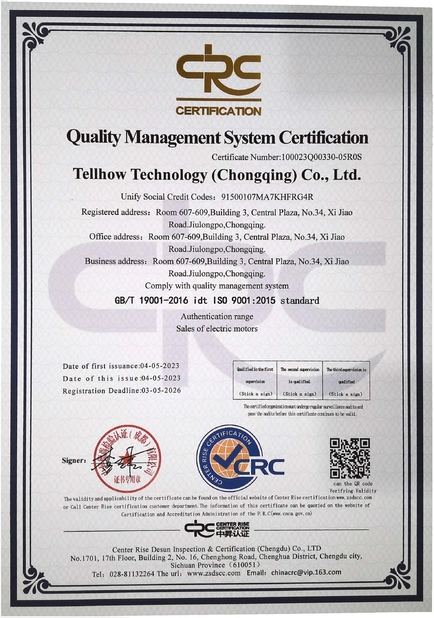
인증
중국 Tellhow Technology (Chongqing) Co., Ltd. 인증
고객 검토
모터는 저소음으로 완전히 운영하고 비디오 원격 설치 안내 서비스가 우수합니다. 우리의 지도자들은 매우 충족합니다.

—— 미샤 글래더쉬첸코

공장은 기술에 대해 매우 혹독하고 심각하고, 우리의 사용 환경에 따라 모터에 대한 세부를 조정하기 위한 매우 과학적 제안을 할 수 있습니다. 이것은 매우 믿을 만한 회사입니다.

—— 최근 미사용 리즈키 아말리아

회사 블로그
Threephase Induction Motors Key Industrial Workhorses Explained
에 대한 최신 회사 뉴스 Threephase Induction Motors Key Industrial Workhorses Explained

What drives the relentless wheels of modern industry? The answer likely lies in those seemingly humble electric motors. Among various motor types, the three-phase squirrel cage induction motor stands out as the undisputed workhorse of industry, prized for its exceptional reliability, cost-effectiveness, and versatility. This article delves into the design, working principles, advantages, disadvantages, and applications of this technological marvel.

Induction Motors: The "Uncrowned King" of Industrial Applications

Induction motors, also known as asynchronous motors, represent the most widely used motor type today. Their simple construction, low cost, and high reliability have made them indispensable across engineering industries. Induction motors primarily come in two variants: single-phase and three-phase.

Single-Phase Induction Motors Include:

  • Split-phase induction motors: Suitable for equipment with limited starting frequency and drive power below 1 kW.
  • Capacitor-start induction motors: Ideal for devices with high inertial loads or frequent starts, such as conveyor belts.
  • Capacitor-start capacitor-run motors: Similar applications to capacitor-start motors but with added run capacitors for improved operational efficiency.
  • Shaded-pole motors: Among the earliest AC induction motors, still used in small devices requiring low starting torque like record players, projector fans, photocopier fans, and hair dryers.

Three-Phase Induction Motors Include:

  • Squirrel cage induction motors: Favored for their longevity and low maintenance, these represent the most common three-phase induction motors.
  • Wound rotor induction motors: Deliver high torque with low starting current, making them suitable for elevators, cranes, and hoists.

This article focuses on three-phase squirrel cage induction motors due to their predominant industrial use.

The Mystery of "Induction": Origin of Rotor Current

The term "induction" refers to the current generated in the rotor windings during operation - a fundamental difference from other motors where rotor current comes from external power sources.

Core Components of Squirrel Cage Induction Motors

Induction motors consist primarily of two major assemblies - the stator and rotor - each comprising smaller components.

1. The Stator: Heart of the Motor

The stationary part consists of housing, stator core, and windings.

  • Stator windings: Receive three-phase AC power to produce a rotating magnetic field. Current flow makes each winding's magnetic field expand and contract. Typically copper-made, though aluminum versions exist.
  • Stator core: Laminated from thin, highly permeable silicon steel sheets, mounted in steel or cast iron frames. The frame bolts to floors with visible external paint. Common materials include various steel grades and cast iron.

2. The Rotor: Rotational Power Source

Located inside the stator, this rotating assembly comprises shaft, rotor core, and squirrel cage.

  • Shaft: Typically slender cylindrical (design varies by model), supporting rotor core, squirrel cage, and bearings. Usually stainless steel for durability, mechanical strength, and corrosion resistance.
  • Squirrel cage: Cylindrical structure around the shaft with connected conductor bars. End rings create short circuits for induced current flow, typically made of copper or aluminum.
  • Rotor core: Thin steel laminations slid onto cage bars and compressed between end rings. Material resembles stator core. Slight lamination skewing increases torque and prevents rotor "locking" between magnetic fields.

3. End Shields and Bearings: Support and Lubrication

End shields mount at both frame ends with shaft penetration. The drive end connects to loads while the non-drive end typically holds cooling fans. Keyways on both shaft ends transmit mechanical motion.

Dust seals between shafts and end shields prevent contaminant ingress - a major cause of motor failure (especially moisture). Anti-friction bearings at both shaft ends ensure smooth rotation with minimal friction. Larger motors use sliding bearings instead, requiring more space, lubrication (usually oil), and different retention methods.

4. Fans and Covers: Critical Cooling System

Axial fans attach to the non-drive shaft end, forcing air over frame exteriors during operation. Frame fins act as heat exchangers with large surface areas for improved self-cooling. Fan guards protect against large debris and personnel safety.

Note: Overheating can melt winding insulation causing shorts - a common but preventable failure with proper cooling.

Advantages and Disadvantages of Squirrel Cage Induction Motors

1. Advantages

  • Wide applicability: Used in ~70% of industrial machinery.
  • Cost-effective installation: No brushes, slip rings, commutators, or sensors reduce costs. Simple structure enables easy installation/maintenance. Brushless design permits hazardous environment operation (with proper modifications).
  • Low maintenance: Significantly lower than DC motors with carbon brushes.
  • Long lifespan: Mechanically robust components with low wear rates.
  • High efficiency
  • Self-starting: Three-phase versions rotate immediately when powered.

2. Disadvantages

  • Poor starting torque: Low starting torque (an efficiency trade-off) makes them unsuitable for high-torque applications, though gearing/pulleys can mitigate this.
  • Low power factor under light loads: Requires high excitation current to overcome air gap resistance, causing voltage lag and reduced efficiency.
  • Speed control challenges: Naturally constant-speed operation makes control difficult, though variable-frequency drives have alleviated this issue.
선술집 시간 : 2026-06-08 00:00:00 >> 블로그 목록
연락처 세부 사항
Tellhow Technology (Chongqing) Co., Ltd.

담당자: Mr. Alex Yip

전화 번호: +86 2386551944

회사에 직접 문의 보내기
Tellhow Technology (Chongqing) Co., Ltd.
3, 센트럴 플라자, No.34, 시 지아오 길을 건설하는 607-609. 충칭. 중국
전화 번호:86-155-23661144
모바일 사이트 개인 정보 정책 | 중국 좋은 품질 고전압 교류 전동기 협력 업체. © 2022 - 2026 Tellhow Technology (Chongqing) Co., Ltd.. All Rights Reserved.