logo
전화 번호:
Tellhow Technology (Chongqing) Co., Ltd.
저희 모터로 에너지를 절약하고 성공을 이루세요!
블로그

Key Insights on Motor Speed Calculation and Applications

제가 지금 온라인 채팅 해요
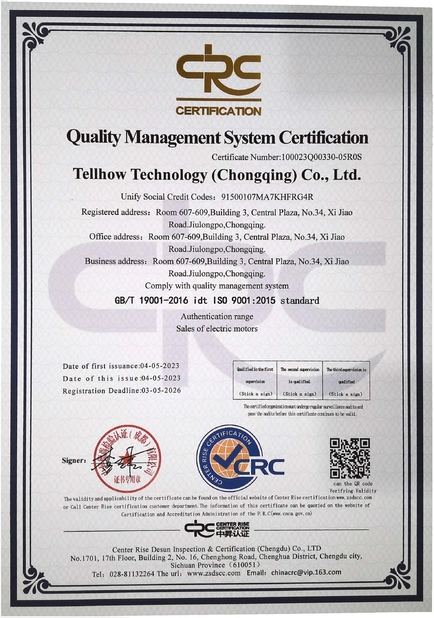
인증
중국 Tellhow Technology (Chongqing) Co., Ltd. 인증
고객 검토
모터는 저소음으로 완전히 운영하고 비디오 원격 설치 안내 서비스가 우수합니다. 우리의 지도자들은 매우 충족합니다.

—— 미샤 글래더쉬첸코

공장은 기술에 대해 매우 혹독하고 심각하고, 우리의 사용 환경에 따라 모터에 대한 세부를 조정하기 위한 매우 과학적 제안을 할 수 있습니다. 이것은 매우 믿을 만한 회사입니다.

—— 최근 미사용 리즈키 아말리아

회사 블로그
Key Insights on Motor Speed Calculation and Applications
에 대한 최신 회사 뉴스 Key Insights on Motor Speed Calculation and Applications
Motor Speed Calculation Methods and Characteristics

In motor operation, maintenance, repair, or replacement processes, understanding technical specifications is crucial. Among these, rotational speed (Revolutions Per Minute, RPM) serves as a fundamental performance metric. This article explores motor speed calculation methods, their significance, and the speed characteristics of different motor types, providing a comprehensive reference for engineers and technicians.

I. Definition and Importance of Motor Speed

Rotational speed (RPM) quantifies how many complete rotations a motor's rotor makes per minute. This measurement applies to various rotating equipment including turbines, centrifuges, and conveyor belts. Accurate speed calculation proves essential for:

  • Motor Selection: Matching speed requirements to motor specifications ensures efficient operation and meets process demands.
  • Fault Diagnosis: Abnormal speed patterns often indicate developing issues, enabling preventive maintenance and minimizing downtime.
  • Control Systems: Precise speed measurement facilitates closed-loop control, optimizing production processes and product quality.
II. AC Induction Motor Speed Characteristics

AC induction motor speed depends primarily on power supply frequency and pole count, unlike voltage-dependent DC motors. These motors typically feature 2, 4, or more poles, with speed determined by the interaction between stator-generated magnetic fields and rotor response.

1. Synchronous Speed

The theoretical maximum speed of an AC motor, synchronous speed calculates as:

Ns = (120 × f) / P

Where:
Ns = Synchronous speed (RPM)
f = Power frequency (Hz)
P = Number of poles

Example: A 50Hz, 4-pole motor achieves 1500 RPM synchronous speed.

2. Slip and Actual Speed

Practical operation sees rotors spinning slightly slower than synchronous speed due to slip—a necessary condition for torque generation. Slip percentage relates to load conditions:

s = (Ns - Nr) / Ns × 100%

Typical slip ranges between 2-5%, with actual rotor speed calculated as:

Nr = Ns × (1 - s)
3. Speed Control Methods

Three-phase AC motors achieve variable speed through frequency inverters, while most single-phase motors operate at fixed speeds matching power grid frequency.

III. DC Motor Speed Characteristics

DC motor speed varies with applied voltage, magnetic field strength, and armature winding turns. Unlike AC motors, pole count minimally affects speed. Operation must remain within rated voltage ranges to prevent excessive wear.

1. Speed-Influencing Factors
  • Voltage: Directly proportional to speed
  • Field Strength: Inversely proportional to speed
  • Armature Current: Inversely proportional to speed
2. Speed Regulation Techniques
  • Armature voltage adjustment (most common)
  • Field current variation (for separately excited motors)
  • Armature circuit resistance modification (simple but inefficient)
IV. Speed Calculation Formulas
AC Motors
Synchronous Speed: Ns = (f × 60 × 2) / P
Slip Percentage: s = ((Ns - Rated Speed) / Ns) × 100%
Full-Load Speed: Nr = Ns - (Ns × s)
DC Motors

Manufacturers typically provide speed-voltage correlation charts. Users should consult these specifications for precise speed adjustment.

V. Practical Calculation Examples

A 60Hz, 4-pole AC motor demonstrates:

Ns = (60 × 60 × 2) / 4 = 1800 RPM
With 1725 RPM full-load speed: Slip = (1800 - 1725) / 1800 × 100% ≈ 4.17%

Other configurations at 60Hz:

  • 2-pole: 3600 RPM (synchronous)
  • 6-pole: 1200 RPM (≈1175 RPM under load)
  • 8-pole: 900 RPM (≈800 RPM under load)
  • 12-pole: 600 RPM (rare)
  • 16-pole: 450 RPM
VI. Maintenance Considerations

Comprehensive understanding of motor specifications enables optimal operation and maintenance. Regular professional servicing helps maintain performance capabilities.

VII. Conclusion

Motor speed serves as a critical performance indicator across selection, operation, and maintenance processes. Mastery of speed calculation principles empowers technicians to maximize equipment efficiency and reliability in practical applications.

선술집 시간 : 2026-02-14 00:00:00 >> 블로그 목록
연락처 세부 사항
Tellhow Technology (Chongqing) Co., Ltd.

담당자: Mr. Alex Yip

전화 번호: +86 2386551944

회사에 직접 문의 보내기
Tellhow Technology (Chongqing) Co., Ltd.
3, 센트럴 플라자, No.34, 시 지아오 길을 건설하는 607-609. 충칭. 중국
전화 번호:86-155-23661144
모바일 사이트 개인 정보 정책 | 중국 좋은 품질 고전압 교류 전동기 협력 업체. © 2022 - 2026 Tellhow Technology (Chongqing) Co., Ltd.. All Rights Reserved.