logo
전화 번호:
Tellhow Technology (Chongqing) Co., Ltd.
저희 모터로 에너지를 절약하고 성공을 이루세요!
블로그

Guide to Synchronous Motors for Industrial Efficiency

제가 지금 온라인 채팅 해요
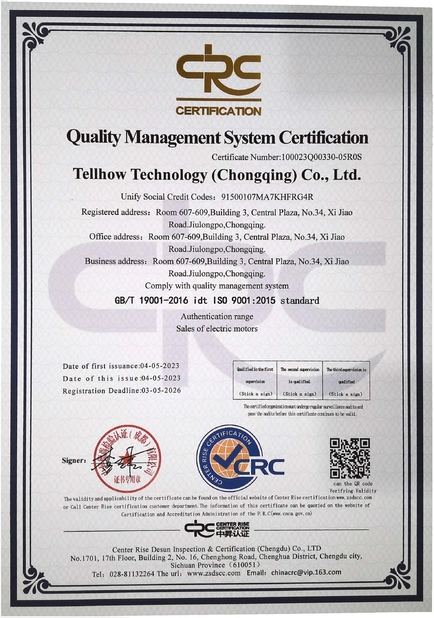
인증
중국 Tellhow Technology (Chongqing) Co., Ltd. 인증
고객 검토
모터는 저소음으로 완전히 운영하고 비디오 원격 설치 안내 서비스가 우수합니다. 우리의 지도자들은 매우 충족합니다.

—— 미샤 글래더쉬첸코

공장은 기술에 대해 매우 혹독하고 심각하고, 우리의 사용 환경에 따라 모터에 대한 세부를 조정하기 위한 매우 과학적 제안을 할 수 있습니다. 이것은 매우 믿을 만한 회사입니다.

—— 최근 미사용 리즈키 아말리아

회사 블로그
Guide to Synchronous Motors for Industrial Efficiency
에 대한 최신 회사 뉴스 Guide to Synchronous Motors for Industrial Efficiency

In large-scale industrial facilities where hundreds of machines must operate in perfect coordination, synchronous motors serve as the unsung heroes providing precise mechanical power. With numerous types available, each possessing distinct characteristics, selecting the wrong motor can range from compromising production efficiency to causing catastrophic equipment failure.

Understanding Synchronous Motors

At its core, a synchronous motor is an AC motor where the rotor rotates at precisely the same speed as the stator's magnetic field—like perfectly synchronized dancers maintaining flawless rhythm. Unlike induction motors where the rotor speed slightly lags behind the rotating magnetic field, synchronous motors maintain constant speed regardless of load variations. This unique characteristic makes them indispensable for applications requiring exact speed control.

Construction and Operating Principles

The key components of synchronous motors include:

  • Stator windings: The motor's core component that generates a rotating magnetic field when energized with AC current.
  • Rotor: Equipped with either permanent magnets or electromagnets, it rotates in perfect synchronization with the stator's magnetic field.
  • Encoder (optional): Provides precise position feedback for servo applications.
  • Cooling system: Manages operational heat to ensure stable performance.
  • Brake (optional): Typically a holding brake that prevents unintended movement when stopped.

The synchronous speed (Ns) is determined by the power supply frequency (f) and the number of motor poles (P), calculated as:

Ns = (120 × f) / P

This speed remains constant under varying load conditions—a critical advantage over induction motors.

Industrial Applications

Synchronous motors excel in industries demanding exceptional precision, efficiency and reliability:

  • Heavy industry: Paper mills, steel plants and elevator systems benefit from their constant speed and high power output.
  • Robotics and automation: Synchronous servo motors provide the dynamic response and precision required for pick-and-place robots, CNC machines and complex motion control systems.
  • Printing and packaging: Linear synchronous motors deliver micron-level positioning accuracy with minimal vibration.
  • Power generation: Their synchronous speed maintenance makes them ideal for power plant generators.
Technical Advantages

Synchronous motors offer several compelling benefits:

  1. Precise speed control: Perfect synchronization between rotor and stator fields enables exceptional speed stability.
  2. High efficiency: The absence of slip means less energy waste compared to induction motors.
  3. Substantial power capacity: Capable of delivering high torque for demanding industrial applications.
  4. Load-independent speed: Maintains constant speed regardless of load variations.
  5. Control versatility: Modern synchronous motors integrate with advanced control systems for precise positioning and torque control.
Motor Varieties
1. Conventional Synchronous Motors

The traditional design maintains exact synchronization with power frequency, ideal for constant-speed applications.

Pros: High power capacity, precise speed control, excellent efficiency, load-independent speed, superior power factor control.

Cons: Complex control requirements, limited speed range, maintenance-intensive rotor windings, higher initial cost than induction motors.

2. Synchronous Reluctance Motors

This newer technology achieves synchronous operation without permanent magnets or rotor windings, using magnetic reluctance principles instead.

Pros: High efficiency (especially at partial loads), robust construction, lower manufacturing costs, favorable thermal characteristics.

Cons: Limited starting torque, high-speed challenges, sensitivity to voltage fluctuations, lower power density than PM motors.

3. Synchronous Servo Motors

Combining permanent magnets with sophisticated control systems, these deliver exceptional positioning accuracy for automation.

Pros: Compact power density, superb speed/torque control, rapid dynamic response, exceptional positioning accuracy.

Cons: Higher cost, requires complex control electronics, speed limitations, rare-earth magnet dependency.

4. Linear Synchronous Motors

Essentially "unrolled" synchronous motors that produce direct linear motion without mechanical conversion.

Pros: Direct linear motion, micron-level accuracy, minimal vibration, high dynamic response, no mechanical backlash.

Cons: Higher cost, specialized control requirements, complex installation, higher power consumption.

Selection Considerations

Key factors for optimal motor selection:

  1. Application requirements: Power/torque needs, speed/accuracy demands, duty cycle, environmental constraints.
  2. Control compatibility: Integration with existing PLCs and control systems.
  3. Total cost of ownership: Including maintenance, energy efficiency and integration complexity.
  4. Engineering tools: Modern sizing tools can optimize motor selection based on application parameters.
Technological Advancements

Recent innovations enhancing synchronous motor performance:

  • Distributed servo drives: Combining motor and controller into single units
  • Single-cable technology: Integrating power, signals and communication
  • Multi-protocol communication: Supporting various industrial networks
  • Advanced safety features: Including torque-off and speed limiting

These developments make synchronous motors more accessible and efficient for modern automation.

Conclusion

Synchronous motors form the foundation of industrial automation, delivering unmatched precision and reliability. Understanding their capabilities and selection criteria enables optimization of both performance and cost-effectiveness across diverse applications.

선술집 시간 : 2026-02-26 00:00:00 >> 블로그 목록
연락처 세부 사항
Tellhow Technology (Chongqing) Co., Ltd.

담당자: Mr. Alex Yip

전화 번호: +86 2386551944

회사에 직접 문의 보내기
Tellhow Technology (Chongqing) Co., Ltd.
3, 센트럴 플라자, No.34, 시 지아오 길을 건설하는 607-609. 충칭. 중국
전화 번호:86-155-23661144
모바일 사이트 개인 정보 정책 | 중국 좋은 품질 고전압 교류 전동기 협력 업체. © 2022 - 2026 Tellhow Technology (Chongqing) Co., Ltd.. All Rights Reserved.