logo
전화 번호:
Tellhow Technology (Chongqing) Co., Ltd.
저희 모터로 에너지를 절약하고 성공을 이루세요!
블로그

Comparing Synchronous and Induction Motors in Industrial Use

제가 지금 온라인 채팅 해요
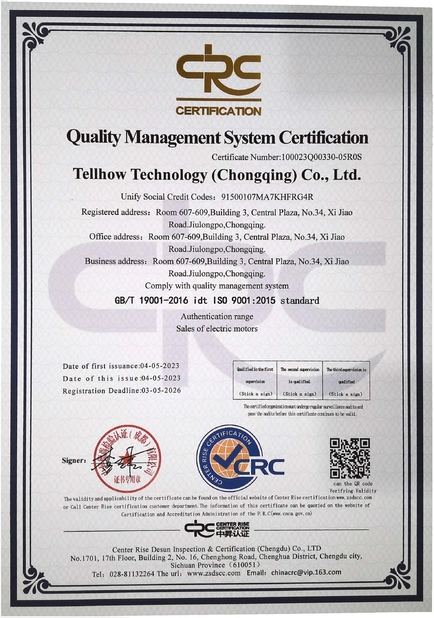
인증
중국 Tellhow Technology (Chongqing) Co., Ltd. 인증
고객 검토
모터는 저소음으로 완전히 운영하고 비디오 원격 설치 안내 서비스가 우수합니다. 우리의 지도자들은 매우 충족합니다.

—— 미샤 글래더쉬첸코

공장은 기술에 대해 매우 혹독하고 심각하고, 우리의 사용 환경에 따라 모터에 대한 세부를 조정하기 위한 매우 과학적 제안을 할 수 있습니다. 이것은 매우 믿을 만한 회사입니다.

—— 최근 미사용 리즈키 아말리아

회사 블로그
Comparing Synchronous and Induction Motors in Industrial Use
에 대한 최신 회사 뉴스 Comparing Synchronous and Induction Motors in Industrial Use

Electric motors, the undisputed power core of industrial applications, convert electrical energy into mechanical energy, driving operations across countless households and industries. Among the diverse family of electric motors, alternating current (AC) motors and direct current (DC) motors represent the two main branches. AC motors can be further divided into synchronous and asynchronous motors, each with distinct operating characteristics and application scenarios.

Consider a precision manufacturing workshop requiring extremely stable rotational speeds to ensure product quality, versus fan and pump applications where frequent load changes demand adaptable motor performance. How does one select the appropriate motor? This article provides an in-depth analysis of synchronous and asynchronous motor principles, characteristics, advantages, and disadvantages to guide informed decision-making.

Synchronous Motors: The Pinnacle of Precision Control

The most notable feature of synchronous motors is their constant-speed operation capability. Regardless of load variations, as long as the power supply frequency remains unchanged, the motor maintains consistent rotational speed. This characteristic makes them ideal for high-precision applications such as:

  • Precision instruments: Textile machinery, precision machine tools requiring strict speed control
  • High-precision positioning systems: Robotics, CNC machine tools
  • Power systems: Synchronous condensers for improving grid power factor

Working Principle: Perfect Magnetic Synchronization

The synchronous motor's constant-speed operation stems from its unique working principle. It relies on interaction between the stator's rotating magnetic field and the rotor's constant magnetic field. The stator winding receives three-phase AC power, generating a magnetic field rotating at synchronous speed. The rotor either receives DC excitation to produce a stationary magnetic field or uses permanent magnets. The stator's rotating field and rotor field attract each other, causing the rotor to rotate at the same speed as the rotating field, achieving synchronization.

The operational process involves:

  1. Stator generates rotating field: Three-phase AC power creates a rotating magnetic field whose speed depends on power frequency and stator pole pairs.
  2. Rotor generates constant field: DC excitation or permanent magnets establish the rotor's magnetic field.
  3. Magnetic synchronization: Interaction between fields causes synchronous rotation.

Starting Methods: Overcoming Inertia Challenges

Synchronous motors aren't self-starting. Initial rotation requires overcoming inertia, typically achieved through:

  • Squirrel-cage windings: Temporary induction currents provide starting torque until near-synchronous speed is reached.
  • External drives: Small asynchronous motors accelerate the rotor before synchronization.

Synchronization Risks

  • Low voltage weakening the stator field
  • Insufficient excitation voltage reducing rotor field strength
  • Overloading causing rotor speed reduction

Advantages and Disadvantages

Advantages:

  • Constant speed unaffected by load
  • Adjustable power factor
  • Higher efficiency at rated loads
  • Scalable for large applications

Disadvantages:

  • Requires starting assistance
  • Higher manufacturing costs
  • Needs DC excitation supply
  • Susceptible to synchronization loss

Asynchronous Motors: The Industrial Workhorse

Also called induction motors, asynchronous motors dominate industrial applications, accounting for approximately 90% of industrial motor usage and over 45% of global electricity consumption. Their popularity stems from simple construction, low cost, easy maintenance, and high reliability.

Common applications include:

  • Fans and pumps
  • Compressors for refrigeration and HVAC
  • Conveyor systems
  • Household appliances

Working Principle: Electromagnetic Induction

Asynchronous motors operate based on electromagnetic induction. The stator's rotating magnetic field induces current in the rotor windings, creating a secondary magnetic field that produces rotational force. Notably, rotor speed always slightly lags behind the synchronous speed (called slip), as this difference enables current induction.

Structural Composition

The simple design comprises:

  • Stator: Laminated steel core with embedded windings
  • Rotor types:
    • Squirrel-cage: Durable copper/aluminum bars short-circuited by end rings
    • Wound rotor: Insulated windings with slip rings for resistance control

Advantages and Disadvantages

Advantages:

  • Simple, low-cost construction
  • High operational reliability
  • Self-starting capability
  • Broad applicability

Disadvantages:

  • Speed varies with load
  • Lower power factor requiring compensation
  • Limited speed regulation capability

Comparative Analysis: Key Differences

Characteristic Synchronous Motor Asynchronous Motor
Speed Constant, load-independent Decreases with increasing load
Starting Requires assistance Self-starting
Excitation External DC required Not required
Power Factor Adjustable (leading/lagging/unity) Lagging, requires compensation
Efficiency Higher at rated load Lower, especially at light load
Cost Higher Lower
Maintenance More complex Simpler
Applications Precision control, power factor correction General industrial, household uses
Low-speed operation Possible with frequency converters (<300rpm) Best above 600rpm

Selection Guidelines: Application Determines Choice

Choosing between synchronous and asynchronous motors requires evaluating:

  • Synchronous motors: Ideal for precise speed control and power factor management
  • Asynchronous motors: Preferred for cost-sensitive applications without strict speed requirements

Modern variable frequency drive technology has expanded asynchronous motor applications by enabling efficient speed regulation. Ultimately, both motor types serve distinct purposes, with optimal selection depending on specific operational requirements.

선술집 시간 : 2026-03-19 00:00:00 >> 블로그 목록
연락처 세부 사항
Tellhow Technology (Chongqing) Co., Ltd.

담당자: Mr. Alex Yip

전화 번호: +86 2386551944

회사에 직접 문의 보내기
Tellhow Technology (Chongqing) Co., Ltd.
3, 센트럴 플라자, No.34, 시 지아오 길을 건설하는 607-609. 충칭. 중국
전화 번호:86-155-23661144
모바일 사이트 개인 정보 정책 | 중국 좋은 품질 고전압 교류 전동기 협력 업체. © 2022 - 2026 Tellhow Technology (Chongqing) Co., Ltd.. All Rights Reserved.